
AI Video Production: Why Human Creativity Still Leads the Process
Discover how AI video production is changing brand storytelling while human creative direction remains essential to creating meaningful, emotional, and effective videos.
AI Video Production: Why Human Creativity Still Leads the Process
Artificial intelligence is changing the way brands think about video. From generating environments to creating visual variations, AI video production is making it possible to achieve ideas that once required larger crews, expensive locations, extensive post-production, or multiple reshoots.
But there is an important distinction that often gets lost in the conversation around AI: technology can generate visuals, but it does not automatically create a meaningful story.
For brands, the real opportunity is not choosing between AI and human creativity. It is understanding how the two can work together.
At Maditrones, we see AI as a creative production tool — one that can expand what a creative team is capable of while keeping human direction, storytelling, emotion, and brand understanding at the centre of the process.
What Is AI Video Production?
AI video production refers to the use of artificial intelligence and generative technologies to assist with different stages of creating video content.
Depending on the project, AI can help with visual development, environment creation, image generation, background replacement, animation, visual effects, content variations, and other production requirements.
This does not necessarily mean creating an entire film with AI.
In many professional workflows, AI works alongside conventional filmmaking.
A real actor can perform in front of a camera. A cinematographer can control the lighting and framing. A director can shape the performance. Then AI can be used to transform the environment or create visual elements that would otherwise require additional production.
That distinction matters.
AI can expand the production possibilities. Human creativity determines what those possibilities should be.
Why AI Video Production Is Changing Brand Storytelling
Traditional video production can involve a long list of requirements — locations, set construction, crew, equipment, travel, shooting schedules, post-production, and reshoots.
That process is still essential for many types of films. But not every visual idea needs to be produced traditionally.
This is where AI-powered video production becomes particularly useful.
Imagine a campaign that requires a highly specific environment that is difficult to access or expensive to recreate. Instead of completely rebuilding the production around that location, a creative team can capture the essential performance and use generative technology to build the surrounding visual world.
The result can be more flexibility during production and post-production.
For brands, this can open up opportunities to:
- Visualise ideas that are difficult to shoot traditionally
- Create contextual environments around existing footage
- Reduce the need for certain physical set builds
- Explore multiple creative directions
- Produce visual variations more efficiently
- Adapt content for different campaign requirements
- Experiment with concepts before committing to expensive production
However, efficiency should never become the only objective.
The goal is still to create something people feel, understand, remember, and respond to.
AI Is a Production Tool, Not the Creative Director
This is where human-led AI video production becomes important.
A generative tool can produce an impressive image. But impressive does not automatically mean effective.
A brand film still needs a reason for existing.
What is the story?
Who is the audience?
What should they feel?
What does the visual communicate about the brand?
Where should the camera be?
How should the subject perform?
What should the lighting feel like?
How should the final frame connect with the campaign?
These are creative decisions.
At Maditrones, our approach begins with understanding the business, audience, positioning, and objective before moving into production. That philosophy is consistent with our wider creative process: listen, define, build, and improve.
AI can accelerate parts of the execution.
It does not replace the thinking that happens before execution.
How We Used AI in Video Production
Our latest video campaign gave us an opportunity to put this approach into practice.
The objective was simple: demonstrate how AI video production can increase production value without removing the human element from the film.
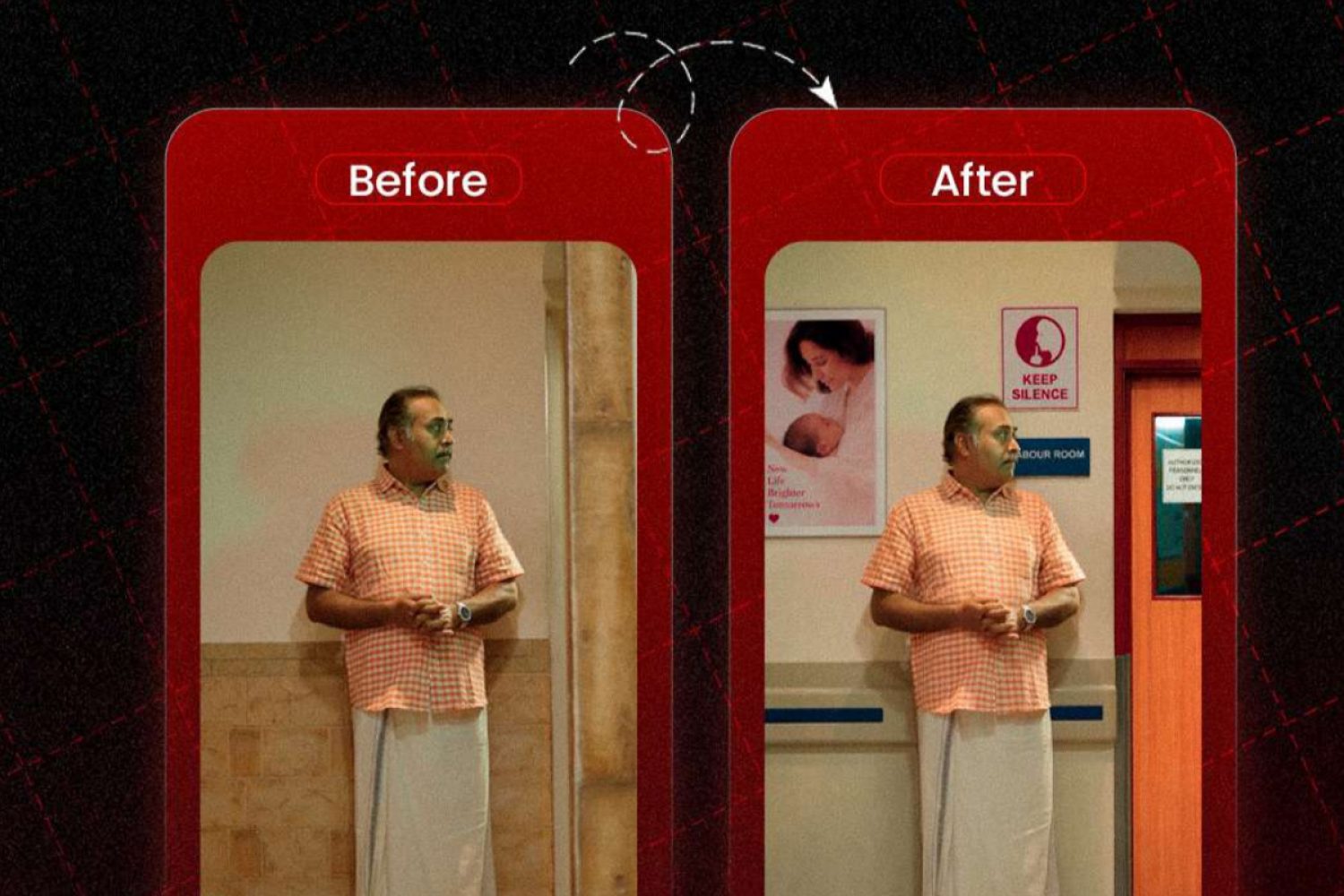
Instead of relying entirely on expensive set construction or additional shoots, we started with basic raw footage and used generative AI to transform the visual context around the subjects.
One example involved creating a realistic hospital hallway environment seamlessly behind the subjects.
The important part was that AI did not determine the entire creative direction.
Human Direction
The human team remained responsible for:
- Scene framing
- Character performance
- Base lighting
- Visual composition
- Story direction
- Narrative intent
These elements established the foundation of the film.
AI Execution
AI was then used to support the visual transformation through:
- Background transformation
- Environmental texturing
- Contextual visual elements
- Realistic signage integration
- Creation of a more convincing surrounding environment
This workflow allowed us to push the production further without compromising the human performance captured in the original footage.
The technology supported the scene.
The people created the scene.
The Real Advantage of Generative AI Video Production
One of the biggest misconceptions about generative AI video production is that its biggest advantage is simply making videos cheaper.
Cost efficiency can certainly be a benefit, but the more interesting advantage is creative flexibility.
Traditional production often has physical limitations.
If you want to change a location after shooting, you may need another shoot.
If the environment is difficult to access, production becomes more complicated.
If a campaign needs multiple visual variations, each version can require additional planning and resources.
AI can reduce some of these limitations.
It gives creative teams another layer of control over the visual world surrounding a story.
That means an idea that once felt impractical can become worth exploring.
And sometimes, that is where the most interesting creative work begins.
Does AI Replace Traditional Video Production?
No — and it shouldn't be viewed that way.
AI video production and traditional video production can complement each other.
There are projects where real locations, physical sets, professional actors, cinematography, practical effects, and traditional post-production are the right choice.
There are also projects where AI-generated environments, visual effects, or generative elements can make the production faster or more flexible.
The right approach depends on the story.
A strong creative team should not start with:
“How can we use AI?”
The better question is:
“What is the best way to bring this idea to life?”
Sometimes the answer is a physical shoot.
Sometimes it is CGI.
Sometimes it is generative AI.
And increasingly, the answer can be a combination of all three.
Why Human Emotion Still Matters in AI Video Production
Technology can generate an environment.
It can transform a background.
It can create visual possibilities.
But audiences don't connect with technology.
They connect with stories, people, emotions, ideas, and experiences.
That is why human creativity remains central to effective AI video production for brands.
A technically impressive video without a meaningful idea can easily become another piece of content people scroll past.
A well-directed video, however, can make people stop.
It can create curiosity.
It can communicate a product benefit.
It can build brand identity.
It can make someone remember the campaign.
AI should help us achieve that more effectively — not distract us from it.
The Future of AI Video Production Is Human + AI
The future of video production is unlikely to be a simple choice between humans and machines.
It will be about collaboration.
Creative teams will continue to develop concepts, scripts, performances, visual language, and brand stories. AI will increasingly become another tool within that creative process.
For brands, this can mean more possibilities, faster experimentation, and greater flexibility in how campaigns are produced.
For creative agencies, it means learning how to use technology without allowing technology to dictate the creative vision.
At Maditrones, we believe that is the balance worth pursuing.
Our work already brings together creative direction, content creation, reels, video production, visual craft, social media, and brand strategy under one creative ecosystem.
AI simply gives that ecosystem another tool to work with.
The technology may change.
The tools may evolve.
The production process may become faster.
But the fundamental question remains the same:
What Story Are We Trying to Tell?
Because AI can help us build the world around a story.
Human creativity is what makes that world worth watching.
More on topic




 Ready to grow your Brand ?